
A year of leadership coaching, and I’m spilling the tea. Something fundamental is changing, and the corporate world is not ready.
I’d originally planned this week’s piece to be about why leadership training doesn’t work and what the (far better) alternative approaches are (spoiler alert: it’s mostly coaching), but that will have to wait. Because I find myself in a much more reflective mood as we near the end of the year.
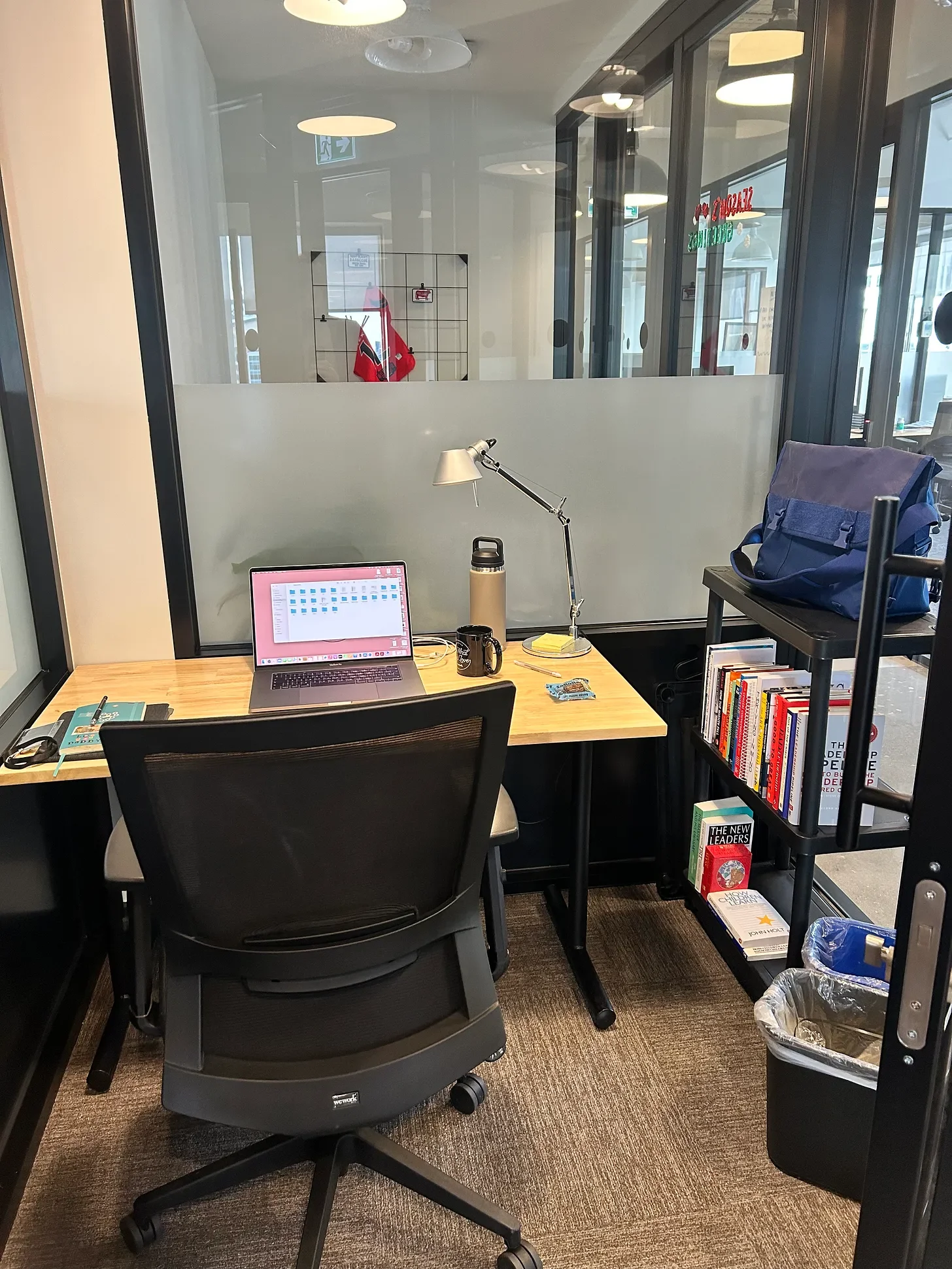
December 2024: Day One at the WeWork
In reality, for most people in the corporate world at least, this is the final week of work of 2025. And based on my own year of coaching people through what’s going on in that world, I can’t shake the feeling that a fundamental shift in the world of work - long predicted - is finally starting to make itself real.
Firstly, some stats from the year, just so you know this isn’t another coach-y “I was talking to a client the other day” puff piece.
I reckon I’ve done around 250 hours of coaching this year, between one-on-one and group sessions.
I’ve been working regularly with 20-odd people. Less regularly with another dozen or so.
Those people come from exactly 14 different industries.
I have worked with clients in Canada, the US, the UK, Europe, India, and Singapore.
In terms of demographics, the age range is early twenties through to early fifties, and it’s a pretty even gender split.
And in terms of what we’re working on, most of my clients fit into one of three situations:
they love their job and the company they work for and they want to get everything out of their opportunities there;
They are completely done with their job and their company and need help getting out;
Somewhere in between - but there is something deeper that is missing, something beyond the world of work, and our focus is on (re)discovering purpose and meaning, based on values, goals, personal experience and so on.
So, after a year of building, that’s what my coaching business looks like right now. I’m incredibly proud of it - having taken this challenge on with no idea of where it would go, I can say that heading into Christmas, I’ve achieved more than I probably hoped for twelve months ago when I set up my little office at the Calgary WeWork.
I can honestly say I love all my clients.
Running airflo, my young leaders group (which is neither only for young people nor is it only about leadership) is the highlight of my month. Some crazy good energy comes out of every call, and those who have done it / are currently doing it have given me some seriously amazing feedback. Not even a humblebrag. I’m pumped about this thing.
airflo: my flagship product and the greatest part of my month
Overall, then, an incredibly positive experience. And an experience which has given me a TON of real-world data on what is actually going on at work.
And the headline is this: the corporate world has become psychologically demanding faster than organisations have become psychologically capable, but slower than top performers have begun figuring out that they have other options.
That’s a lot of words, but I think I need them all in order to convey what’s happening accurately. I’ll try again, in a more concise format for the diagonal readers out there:
More stress;
Limited corporate capability (/ willingness) to respond to it;
Increased personal understanding of the alternatives to “just riding it out”.
Let me explain, through the lens of three perspectives which establish how I’ve reached this conclusion.
(If you’re still with me, I appreciate you, you obviously care / are interested / relate to what I’m saying, so I’d love to hear from you).
Number one: as roles and titles have been inflated, authority has been deflated.
Too many people are carrying the weight of expectation that comes with leadership with neither the tools nor the authority to actually lead. This looks like:
accountability for outcomes they can’t fully control;
expectation to “lead” without clarity around what exactly they are leading and what those expectations actually are (or what the future might hold);
smart people being positioned between strategic influence and operational reality - an impossible balance in most organisations.
And how do I know this? Well, simply because of the sheer number of conversations I’ve had where my clients are:
frustrated, but that frustration is turning into self-doubt (paralysing self-doubt, in some cases);
high performers asking themselves why they can’t solve problems they way they used to (in other words, “where did my performance go??”;
being held to account for outcomes caused by structural deficiencies they cannot change.
Number two: metric-based performance is rewarded above intuition and common-sense outcomes.
I work with really smart people. Honestly. All of them have achieved a lot, some in short space of time, some over the course of a long and well-managed career. But most of them report being measured and rewarded mainly for speed, output, responsiveness, and bare productivity. Almost none of them report a world in which their intuition, their ability to slow things down and give full consideration to the problem at hand, or their ability to say “this doesn’t make sense yet” and send something back for rework are valued in the same way.
Again - my evidence is the conversations I’m having where my clients are spending large amounts of their time producing workarounds to defective systems. Where they are approaching (or in the middle of) burnout because the “high standards” were actually “impossible standards”. And where they are pressurised to produce clarity out of a complete mess.
As Richard Feynman famously wrote in his report into the Space Shuttle Challenger failure: “…for a successful technology, reality must take precedence over public relations, for nature cannot be fooled”.

The Challenger disaster: “…nature cannot be fooled”.
Number three: identity and role have become indistinct, and the emotional toll is significant.
Now this one sounds a little woolly, but bear with me.
As awareness around mental health in the workplace has grown (and thank God), organisations are scrambling for ways to respond. One of the default outcomes (and by default, I mean nobody actually intended this, but it’s happened anyway and nobody’s stopping it) is that leaders are suddenly required to be part strategist, part decision-maker - and part therapist.
Quite clearly, this is not realistic. And the feelings of guilt at not “being there” for a team member the way someone may be for, say, a friend or family member, is significant. There is a huge amount of damage being done to leaders’ self-worth deriving from this gap.
But how can that expectation possibly be maintained? Colleagues, however dear, cannot always be held in the same place in our hearts as friends or family members.
So vulnerability is being encouraged. But there is a lack of organisational maturity to address what emerges from that vulnerability. The emotional infrastructure is still shallow, but everyone is being encouraged to relate to each other with greater depth.
It’s a mess.
I hear my clients constantly “monitoring” themselves in this way. Feeling like the “servant leadership” thing is where they should be orienting themselves. And on the other side of the coin, feeling like nobody’s actually there for you when you’re in crisis, even though you’re expected to be there for your team.
Again, it’s a mess.
But what do we do about it?
Well, most of this I’ve learned along the way. And I’ve had to adapt my approach to helping people through these moments.
The most important thing to say is: my coaching never has had and never will have any agenda. I want people to feel good where they are. If that means moving on, then so be it, but only if that’s my client’s decision, and just as often, staying put is part of the solution.
But more than that, I have tried to see coaching as being the missing piece of a wider system. As a place where thinking through options is allowed. Where personal skill gaps can safely be acknowledged and explored. And where people can separate who they are from what they do. Where role and identity can be decoupled again, back to their separateness, where they belong.
Without this opportunity, people are seeing that there are other routes to work, and they are voting with their feet. So no - you can’t do nothing.
I could go on. But I can conclude with perhaps a more hopeful note.
By offering these spaces for their people to talk and explore what’s going on, organisations can fill the gaps I’m identifying here. It really is as simple as that. People just need a place to talk.
No, it’s not HR.
No it’s not their line manager.
And no, it’s not your Employee Assistance Program.
It’s something like coaching, but I still don’t like that word and probably never will.
All I know is, if you have these problems in your organisation, working with a partner who creates an opportunity for real conversations at work will take you a long way towards solving them.
Anyway. This article is already too long. So I’ll end with this: if you’re sitting there in a leadership position, scoffing at all this and thinking you’ve heard it all before, ask yourself: do your people agree with you?
Merry Christmas. And here’s to brighter futures all round.