
No 5am club or cold plunges required: Seven (more) habits of highly effective people

I want to tell you about my friend Sam.
I have known Sam for a few months. We met on a volunteering drive, posting leaflets for an event called Christmas Wishlist at our church (Christmas Wishlist is incredible by the way - check it out and sponsor a family if you feel the call).
Sam is 20. In my mind, this means he and I are relatively close in age, but I asked ChatGPT just to be sure, and it turns out that I am over twice as old as him.
This came as quite a shock.
Despite this, he seems willing to talk to me when we run into each other and I enjoy his quirky sense of humour, his spaniel-esque energy, and his optimism.
This weekend, we were chatting about social media, brain rot, and mindless scrolling. Caleb, around the same age as Sam, was there too. And what they said about this very modern malaise surprised and reassured me.
These two young men, members of the supposedly technology-addicted and self-absorbed Gen Z, consumed by the feed, their futures and their cognitive function doomed, the world’s first digital natives, both told me they essentially couldn’t give a rip about social media.
Not that they didn’t appreciate or worry about its addictive pull. But that they - and their friends - had actively taken steps to say no to it.
Sam had asked Caleb to set a password on his phone limiting his online time to 15 minutes a day. And only Caleb had the password. And he wouldn’t give it up if Sam begged him.
Caleb, for his part, does not have Instagram or TikTok on his phone. Instead, he uses an app called BeReal - which gives you a feed, but only of your friends (meaning real, in-life, 3D friends). The app suggests a random time in the day when you can post - and you can only post in that window, meaning that whatever you’re up to in that moment is what goes on your feed. No curated, high gloss lies. If you happen to be doing dishes or rearranging your sock drawer at that specific moment, that’s what goes up.
The app also kicks you out when you’re done updating on your friends’ posts. Caleb showed me his feed. A dozen or so meaningful, entertainingly humdrum images from people he actually knew and cared about, and that was it. The bottom of the feed bears a message saying “That’s it, you’re done for the day” - and you can only close the app. The whole thing took about 11 seconds.
All of this got me thinking. It looks like there is a movement among Gen Z to stop the scroll and get back to real connection. They are drinking less. They have greater awareness of mental health issues than any generation before them. They are taking care of themselves, and each other.
And - at the risk of sounding like someone twice Sam’s age (I guess I’ll just have to accept that’s true) - I think the rest of us are finally starting to catch up.
>><<
Stephen Covey wrote his iconic self-development book The Seven Habits of Highly Effective People in 1989. It has sold over 40 million copies worldwide.
And the things he talked about are - remarkably - all just as valid today as they were 37 years ago. The seven habits (being proactive, defining long-term goals and values, prioritising tasks, seeking cooperation, understanding others’ perspectives, working with those with strengths complementary to yours, and continually learning and growing) are still what I see displayed among my most successful clients.
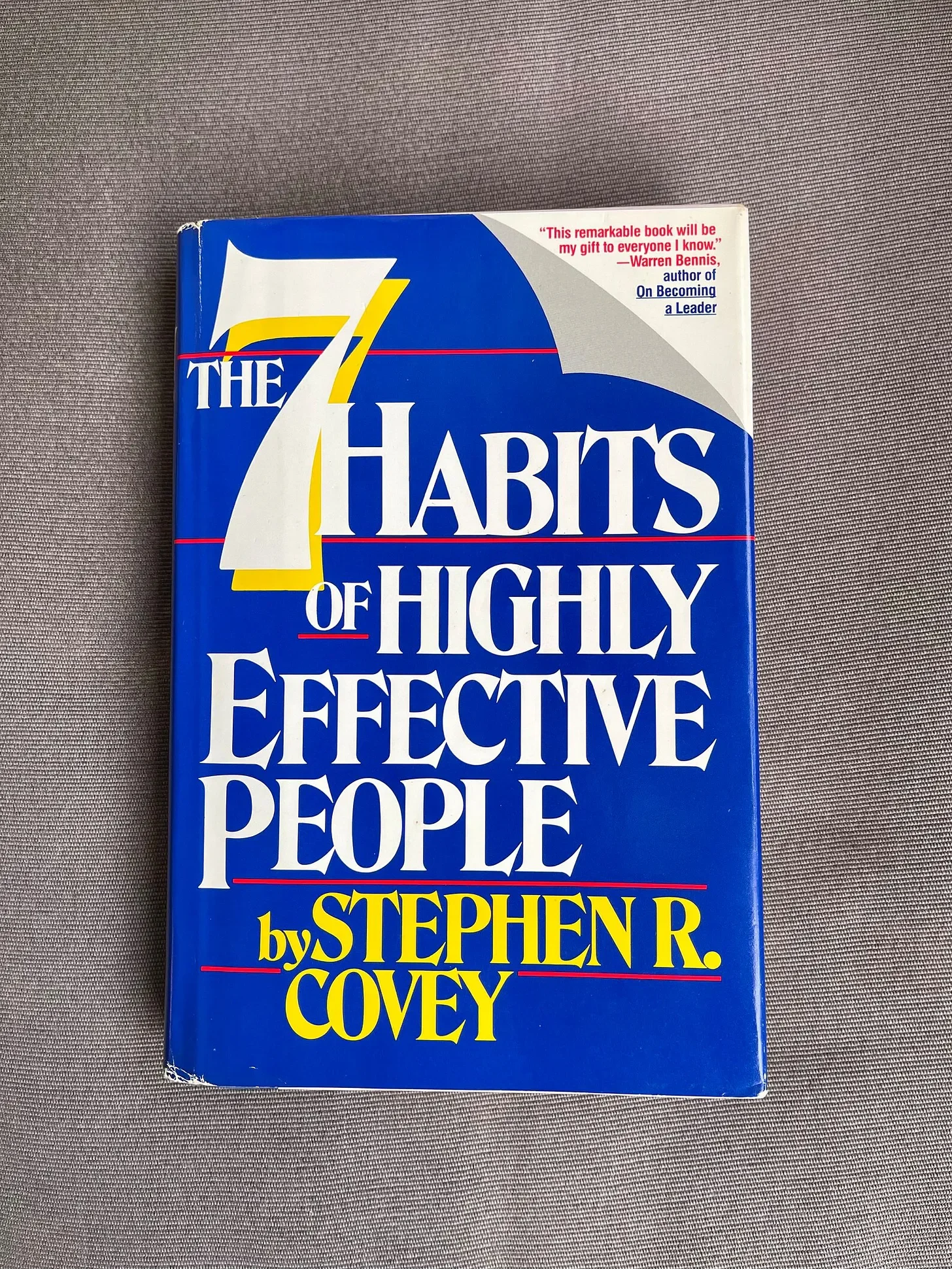
The first edition of Seven Habits, published in 1989
I guess that is why the book has sold so many copies. Covey nailed it. It’s pretty obvious that anyone who sticks to those seven habits in pursuit of a useful purpose will at least experience some kind of positive outcome.
But my conversation with Sam and Caleb did get me thinking about whether anything could be added to Covey’s list.
I thought about my clients. Smart, successful, personable, emotionally-engaged people. Seekers, too; almost all of them believe there is more in store and they want to unlock it.
I thought about my clients, and why they come to coaching in the first place.
I thought about my clients and what they bring to our sessions and what they tell me they want and the strategies we identify for making it happen, and I came up with a list of seven more habits of highly effective people in 2026. This complements the original seven, but reflects what I think is a permanent move towards self-reflection and balancing all of a person’s needs and desires.
Sometimes this has been called work-life balance; but that is glib, reductive, and unattainable. There’s more to it than that, from what I see - and my clients’ experiences reflect that. In fact, the smartest ones tell me they don’t believe in work-life balance. Instead they are looking for something as close to harmony of all the competing pressures on their time and energy as possible.
Anyway - on with the list. I don’t dare to hope this will still be relevant in 37 years’ time. No: this is a snapshot of what feels true today. I am happy to acknowledge it will age like milk. So, with that caveat, here goes. Seven more habits of highly effective people (with apologies to Stephen Covey):
They don’t stay stuck.
They know how to roll with failure.
They know how to notice and act on health warning signs.
They are no longer in love with productivity.
They know that more isn’t necessarily more.
They have spiritual awareness.
They have a Plan B.
They don’t stay stuck.
In 2026, highly effective people do not blame external circumstances for their situation or their state of mind. They take ownership of what’s going on, address it, develop strategies for getting out of it, and build accountability structures for sticking to that plan.
In my context, coaching has been a big part of their approach here. They have sought out a place to share what’s going on, express their dissatisfaction with it, and figure out how to change it. They’re not sitting tight and complaining, or anaesthetising themselves with busy-ness or distraction. They’re facing hard truths and preparing themselves for big decisions.They know how to roll with failure.
The most effective people I am working with right now have learned to make failure part of the process. You hear about this a lot, I realise. This isn’t anything earth-shatteringly new. But talking about it is one thing; actually doing it is another. Today’s corporate environment is engineered to reduce risk and stifle innovation. Decision-making has become so technology-driven that there is less and less room for intuition when solving problems. We look to data for the answers.
There’s a place for that. But when data gives us the wrong answer (which yes, it does, a lot) we blame the data. That’s not the same thing as following our best determination of what to do, derived from our experience and our reasoning ability and our cognitive power, and then adapting and learning from the results as we go. When we get it wrong, there is only one person to blame. Highly effective people know that, and take the risk anyway, because in the worst case, they will at least learn something.They know how to notice and act on health warning signs.
If people are still ignoring the signs of burnout and excessive negative stress, they’re not the ones who come to coaching. At least, that appears to be the evidence in front of me. Because the smartest people I’m working with right now are not necessarily the most resilient, or the most “successful”, or the most dynamic or the most charismatic (or at least, that’s not what presents). They may be one or all of those things too - but what really defines them is they know something’s up and they know they need to do something about it.
Mood swings. Lack of interest in socialising. Poor digestion. Constantly feeling tired (no, it’s not normal). Diminished attention span. Insomnia. Increased cynicism or detachment.
All classic signs, and all hard to ignore if you’re looking. And the most effective people are looking, and they’re taking steps to do something about it.They are no longer in love with productivity.
Or at least, “having a productive day” is no longer the pinnacle of human achievement it once was. Traditional metrics of professional success are losing their weight. Job titles, meaningless perks, all of that. It still counts, but it’s a fringe, a decorative piece; something that looks good, but isn’t necessary. Productivity as a goal in and of itself is fine, but I have far more clients who are looking for something besides productivity than I do clients who are looking for more productivity.
And that something? Well, invariably it looks like this: agency. Autonomy. Purpose. Fulfilment. Things that satisfy the whole self, mind and body. That’s what people want in 2026.They know that more isn’t necessarily more.
More of the same kind of success. More money. More power. More influence. Again, it is not my view that there’s anything inherently wrong with these things. It’s more that people are realising that wanting them for their own sake is ultimately highly unsatisfying. So what comes instead of more?
Well, instead comes instead of more. Instead of more, I want something else. More is not necessarily more. But different might just be. A career change. A role change. A side hustle. Or even just some new perspectives on what’s going on. The most effective people I know are looking for their different. Something new that will keep life feeling fresh. Some variety. A change. Change is good. Effective people know it.They have spiritual awareness.
If the gold standard of personal development of self-awareness (and I think it is), then the next level up from that is spiritual awareness. I’m not necessarily talking about any kind of religious faith here - although that is very often the case - but more broadly, the most effective people I am working with know that there is something else above and beyond themselves and that it is a fundamental part of the human condition to need to address it. We have souls. I don’t care what anyone says. We are not just flesh and bone. Our spirits need attention.
For some people, it’s God. For others, it’s connection with nature, or playing music, or meditation. For many, it’s all of these things. Sadly, for many others, it’s none of them - and this, from what I’m seeing, is what is drawing a line between effective people and directionless people today.They have a Plan B.
Without exception, the most energised and purposeful people I know (that is, the most effective) are the ones who have something else up their sleeve. They’re not entirely reliant on a role with a company and a salary to define their purpose and sense of place and identity in the world. They have other interests which could one day be turned into a living. They are training for something else. They are learning new skills. They are studying. They are starting small businesses. They are developing a voice online and have the beginnings of a personal brand in mind. Because if you have a Plan B, there’s no need to be so afraid of Plan A going wrong. In fact, having a Plan B is often what allows smart people to let Plan A go wrong in the first place.
>><<
Sam and his friends have identified that nobody is going to save them from themselves. They realise that excessive social media use is one of the many hazards of this life, and they’ve taken steps to take back control and armour themselves against it.
The most effective people I am working with today do this at a “whole life” level. They take back control. They armour themselves. And if I had to wrap up my seven new habits, it would be in one word: agency.
Agency means divorcing ourselves from external metrics. It means coming back to the highest expressions of purpose and meaning. It means reacquainting ourselves with thing we’ve known for thousands of years, but seem to have forgotten. It means reclaiming our humanity and embracing the messiness that comes with it.
Not staying stuck. Making room for failure. Staying healthy. Claiming purpose over productivity. Looking for different, not more. Paying attention to our souls. And having a Plan B.
That’s what effective people are doing in 2026.