
What it really takes to start a business: Three case studies on usefulness

Artsy depiction of usefulness.
If you’ve never heard of the reddit subthread LinkedIn Lunatics, I highly recommend a browse. I won’t say it’s the most positive or uplifting or cleansing thing to do, but we all enjoy a little snark every now and again - and there’s nothing snarkier than LinkedIn Lunatics.
It describes itself thus: “A subreddit for insufferable LinkedIn content. Scroll through LinkedIn and you will find a mix of rampant virtue signaling, cringeworthy titles, and stories that could come from r/thathappened. This subreddit is for sharing and discussing these LinkedIn characters.”
Unsurprisingly, it’s a popular thread, with over 1.3 million weekly visits.
I’m not going to include any specific examples here, but the thread is a case study in how we feel about LinkedIn generally.
It’s useful, yes…but it comes with a large slice of “ick”.
And we all have our own personal bêtes noires when it comes to LinkedIn. Mine? Vacation posts masquerading as personal sacrifice (sorry, there’s nothing noble about two weeks all-inclusive). And anything that starts “I used to think…” followed by some half-baked enlightenment (no you didn’t). And one I think we can all agree on: AI slop. Yes, we can tell you didn’t write this, and no, I’m not going to read it. Stop it.
But it’s wise not to get too snarky; the nature of social media, if you’re posting on a semi-regular basis like I am, is that you’re almost certainly annoying someone. I’m sure I’ve posted something at some point that could find its way to LinkedIn Lunatics *shudder*.
So yes, when it comes to LinkedIn, you have to take the rough with the smooth. If you want the picnic you have to put up with the flies.
Because what I’ve found after a little over a year of regular engagement with the platform is that, with patience (and some refining of your feed, aka blocking the content you can’t stand) it remains an incredibly powerful way of meeting great people. People you would probably never otherwise end up finding or connecting with.
People like Avion, Sam, Emily, Mackenzie, Amanda, and Anthony.
»«
I’ve written before about usefulness, and it’s becoming a bit of an obsession of mine (I’m keeping a note on my phone of useful stuff I come across). The more I think about it, the more I think it’s the single biggest thing (outside our own values and belief systems) behind how good we feel as we live out our lives: the extent to which we are useful. That will look different for everyone, of course - it’s values-driven, and highly contextual - but you get my point.
This week I want to spotlight three pairs of founders I have connected who are building something useful, and who I connected with entirely as a result of spending time on LinkedIn. I want to talk a bit about the incredible things they’re building. And I want to identify what their efforts reveal about what it’s like to do a very hard thing: starting a business building something new and unique. Because it would be all too easy to conclude that building a business is all big announcements, deep insights, neat Disney-esque narratives of struggle and triumph. What I’ve learned, getting closer to people actually doing it, is far more interesting.
I’ll start with Avion Gray and Samantha Rosenberg. Avion and Sam are building Belong, a UK-based investing platform that uses behavioral science and product design to help first-time investors get started. One of the core features of the platform is the access to deposit-matched lending (meaning you can borrow against your investments), a leveraging option previously only available to High-Net-Worth investors. This may seem simple, but it’s a radical approach to democratising wealth-building.
I first found about Belong, and connected with Avion and Sam, just over a year ago through a mutual contact on LinkedIn. Without that algorithmic relay, the chances are I might not have heard of their work when I did (although I’m certain that eventually I would have anyway, as I firmly believe that Belong is going to be big).
Since then, we have kept in touch whenever time permits, comparing notes and sharing updates. Avion is speaking at an upcoming session of my airflo group.
What Avion and Sam are doing is hard. “Disruptive” is an over-used word, but what they are doing truly is turning a traditional model on its head. They’re building into a highly regulated space. And that’s on top of the inherent difficulties faced by any startup: getting the sequence right; getting early traction; raising funds. But they are doing it with humanity, and heart, and conviction that there is a problem that can be and needs to be solved. It is, without question, useful.
»«
Sometime last year I wrote about my time, early in my career, working at Buckingham Palace (story for another time).
That post resulted in me reconnecting with several former colleagues, including Amanda Nunn. Amanda and I didn’t quite overlap at the Palace - she left not long before I joined - but we had plenty of common ground and common friends so we met to compare notes. I shared a bit about going from Royal service to private banking to running a coaching business, and she told me she had a top secret thing she was working on, but not quite ready to reveal.
My curiosity piqued, we met again a month or so later and she introduced me to Anthony Jenking, her co-founder, and they told me about Privu. And I was instantly hooked on the idea.
In several of my previous roles I was required to extract data about UK companies from the Government registry, known first colloquially, then officially, as Companies House.
Anyone who has had to do this before knows what a bureaucratic nightmare it is, even for simple company structures. Nothing is click-through. Nothing lends itself to navigation. Nothing facilitates interrogation of the information presented. It’s all just a sea of dead-end black text. When it comes to complex structures with multiple layers of shell ownership, well, good luck. It’s structured opacity pretending to be transparency. Not so much look-through as look-away-now.
Amanda and Anthony’s platform doesn’t just solve that problem, it creates a new paradigm for ownership, financial, and regulatory transparency for UK companies. When they first pulled the tool up on the screen-share, I could hardly believe what I was seeing. All that dead-end black text has become cross-referenced insight generation into the ecosystem of company ownership for every public company in the UK. It creates visibility linking ownership to interest, and multiple layers of opacity to become truly “look-through”.
Not only that, it has so many applications: angel investors looking to track their portfolio; financial institutions with regulatory “know your client” obligations; professional services firms, M&A transactions, due diligence consultancy - so many people need this. And as I said before, the existing sources are painfully clunky.
Amanda and Anthony are building something undeniably useful. In the purest sense, it is a solution to a problem (more on that later).
»«
My connection to my third pair of founders came out of a more personal situation. I’d written here before about some of the lessons from addiction treatment. I have, as far as I am able (which is not to say much) been supporting someone very close to me on this journey in the past several months.
There can be few environments that shine a more revealing light on the human experience than addiction support meetings. And the psychological therapy elements of treatment are, from my perspective as a witness to them, things that should be included in every school curriculum: emotional regulation; overcoming negative self-talk; processing setbacks; handling rejection; overcoming traumatic events and experiences. Indispensable life skills, whatever your life looks like. Imagine if every kid left school with those skills? Still, at least we learn long division.
But I digress.
I first came across Emily Bargabos’s work through her Substack(she’s a gifted writer), and, because of my interest in addiction treatment, took a harder look at what she was working on. We met and shared stories and not long after that she introduced me to her co-founder Mackenzie O’Connell.
Emily and Mackenzie are building Steady, a toolkit (available now on the app store) to support those recovering from addictive behaviors. It brings together an AI-powered support chat function, breathing exercises, journal prompts, challenges and learning resources, as well as providing a connection to others on the same journey, and a Strava-style activity tracker so your connections can check in on your progress.
It’s a truly unique take on the problem. What Emily and Mackenzie have identified from their own experiences is that recovery from addiction takes multiple different inputs. It’s not just therapy, it’s not just rehab, it’s not just supportive friends and family, it’s not just faith or willpower or determination: it’s all of this things combined (and more) that bring the best chances of success. Steady adds an new resource to that ecosystem. It’s a truly great idea.
And - guess what - it’s useful.
»«
It’s been such a privilege to meet and learn from these great people and the things they are working on.
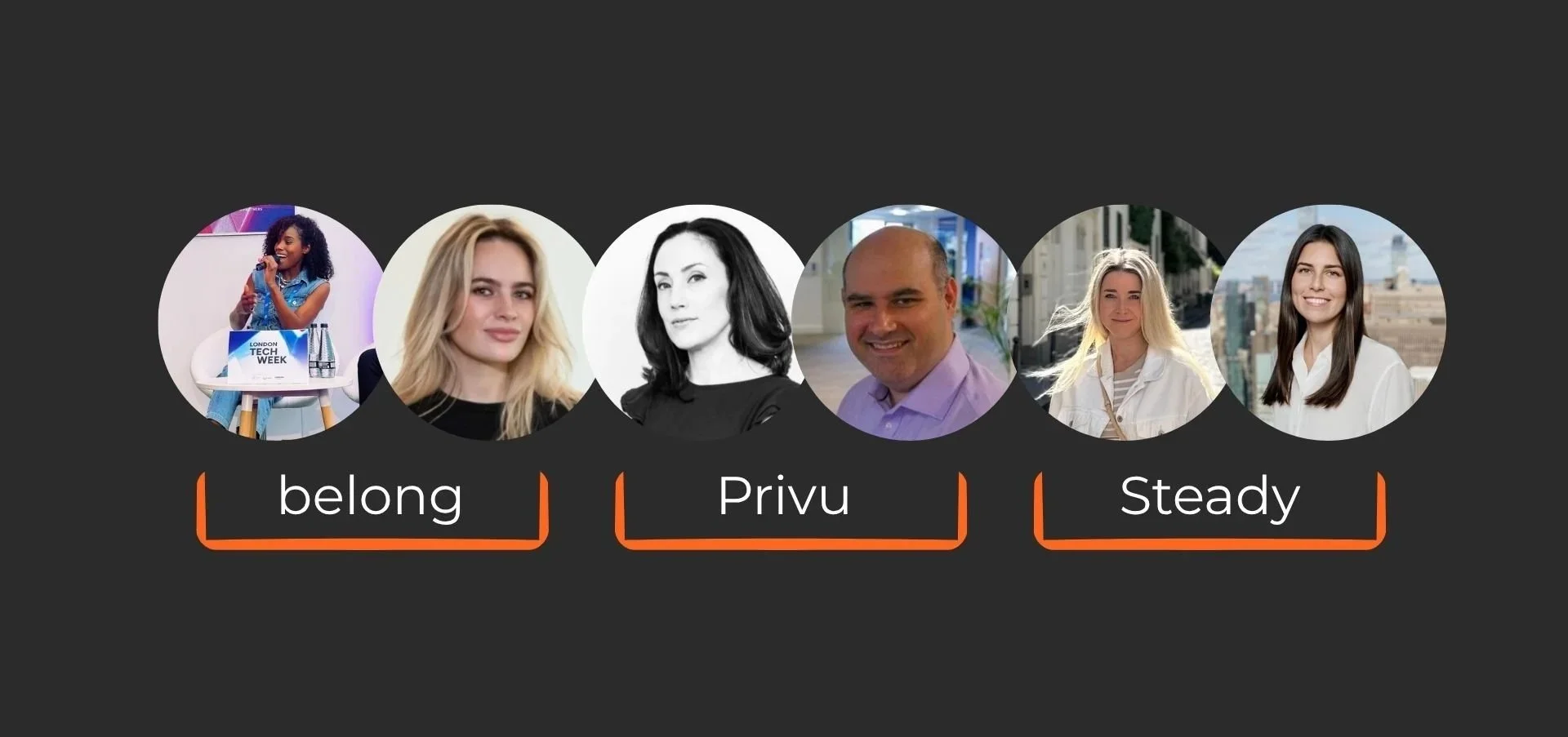
The Useful Founder Dream Team. L-R: Avion, Sam, Amanda, Anthony, Emily, and Mackenzie.
Belong, Privu, and Steady are three really different ideas in really different spaces. And their founders are all just as unique.
But there are a few commonalities I see from what they are doing, and how they are doing it:
commercial viability does not have to be separate from social benefit;
great solutions are derived from real problems, not the other way around;
in early-stage startups, a solid MVP is king.
…all of which relate to the products more than to the people building them. And what I’m always more interested in is the who, rather than the what. And here I see four ways that Avion, Sam, Amanda, Anthony, Emily, and Mackenzie are showing up that I think would be great takeaways for anyone looking to lead their own “thing” better:
They balance pride with humility. Huge amounts of pride and conviction in what they are building, balanced with the humility to know what they don’t know, to work through problems, and to wait until it’s really time to ship. The Swiss have a great (if slightly fusty) saying: as fast as possible, as slow as necessary. That’s a great characterisation of leadership humility.
They balance pragmatism with excellence. The pragmatism to know that everything will not be perfect, that the first version of anything tends to “need work”, and that it’s better to deliver something good than not deliver something perfect. And the standard of excellence to do as good a job as possible with the resources and skills available. It’s not an easy balance to strike.
They know and grapple with the challenge of concurrently building the solution, and building visibility. The core of the work needs doing; without it, there is no product. But the product also has to be known about, and finding smart ways to get the word out with early-stage startup budgets is key.
They know that nothing matters more than traction. Traction builds traction. This is true of any venture: an investment platform, a professional services tool, a health and wellness platform…and a coaching business. Investors want traction. Traction brings investors. So, I talk about these three ideas and their six founders because I, in turn, want to be useful, and because I believe that they are and will be useful to so many others (if you agree, then share this piece).
»«
I’m aware that this is more of a brain dump of some interesting experiences that I wanted to share than anything else. I’m not sure exactly what the overall takeaway is.
It’s not that LinkedIn is full of nonsense (even though it often is). It’s not that every founder’s journey is a deep lesson in leadership and getting stuff done (although they often are).
I think maybe it’s about the questions we ask ourselves when we set about our day. What do I want from that meeting? Who do I need to chase for an answer on this project? Where do I need to get more from my team?
What would happen if instead, every day started with this:
How can I be useful today?