
Trigger warning: rant incoming.
Because this week I’m going to write about the cult of servant leadership and why I think it’s one of the falsest idols (among many) that are worshipped in the world of corporate culture and personal growth.
This won’t just be the airing out of a personal opinion (ok maybe a bit). No, the evidence-seekers among you will not be left unsatisfied. For I come armed with proof: in particular, the experience of my clients who have been led into the myth of the servant leader as a standard to which they must aspire, and who have found themselves become at best ineffective, and at worst, completely burnt out by it.
Take a few minutes to browse the world’s most popular professional social network and you’ll find no shortage of effusive praise for the servant leader doctrine. “A bottom line strategy, not a soft skill”, says one contributor. “The truest form of influence comes through service”, adds another, accompanied, mystifyingly, by an AI-generated picture of a bath towel.
There are servant leader membership groups where, presumably, the world’s greatest leaders meet to argue about who should be organising the meeting.
There are even executive coaching companies (yes, more than one) which have chosen the phrase as their legal name. Now that’s a niche. One I don’t want to work for. Ever. Thanks.
But where does this all even come from? Well, after extensive research (I googled it), the concept appears to originate from an essay written in 1970 by a guy named Robert K. Greenleaf (I don’t know why the K was important. Maybe there was another Robert Greenleaf who was a despotic micro-managing tyrant).

Robert K Greenleaf. Picture credit: Gonzaga University
Greenleaf was inspired by the novel Journey to the East by Hermann Hesse (personally I prefer its original German title, Die Morgenlandfahrt). In the novel, a disparate group of well-known fictional and real characters (ranging from Mozart to Don Quixote) embark on a spiritual pilgrimage to “the East”, which initially goes well, but falls apart when the group’s servant, Leo, disappears. Bickering ensues.

The Journey to the East, Hesse
To cut a long story short (actually, to cut a medium-length Wikipedia entry short), years later the narrator of the story finally locates Leo, who reveals himself to have been the leader of the group in disguise, and tells our hero that his disappearance was a spiritual test to the members of the group, which they all failed. Sort of a 1930s version of that Undercover Boss YouTube channel.
Greenleaf considered this story and, in a foreshadowing of every LinkedIn brand-builder’s playbook, built, well, a brand. He took this notion of a leader in disguise as a servant and used it as the founding premise for something called The Greenleaf Center for Servant Leadership, which exists to this day.
(Side note: I only just found that out as a write this, and I’m now wondering how much of this I’m going to have to edit to avoid any defamation charges).
This august institution defines servant leadership as “a non-traditional leadership philosophy, embedded in a set of behaviours and practices that place the primary emphasis on the well-being of those being served”.
Served? Or led? I’m lost. And so must they be.
To briefly bring a bit of balance to this, it does look a bit like the trendification of servant leadership has taken us away from what Greenleaf originally had in mind. And don’t misunderstand me: as a leader, it is clear that the well-being of those you are leading is extremely important. But what I do have a problem with is that this should be the primary emphasis.
Why?
Well, two reasons.
Corporations do not exist primarily to ensure their employees’ wellbeing.
Profit-making enterprise does not have as its primary goal the wellbeing of the people it employs in the pursuit of that profit. Jamie Dimon, CEO of JPMorgan, said it best: “It is YOUR job to take care of your mind, your body, your spirit, your soul, your friends, your family, your health. YOUR job. NOT ours.”
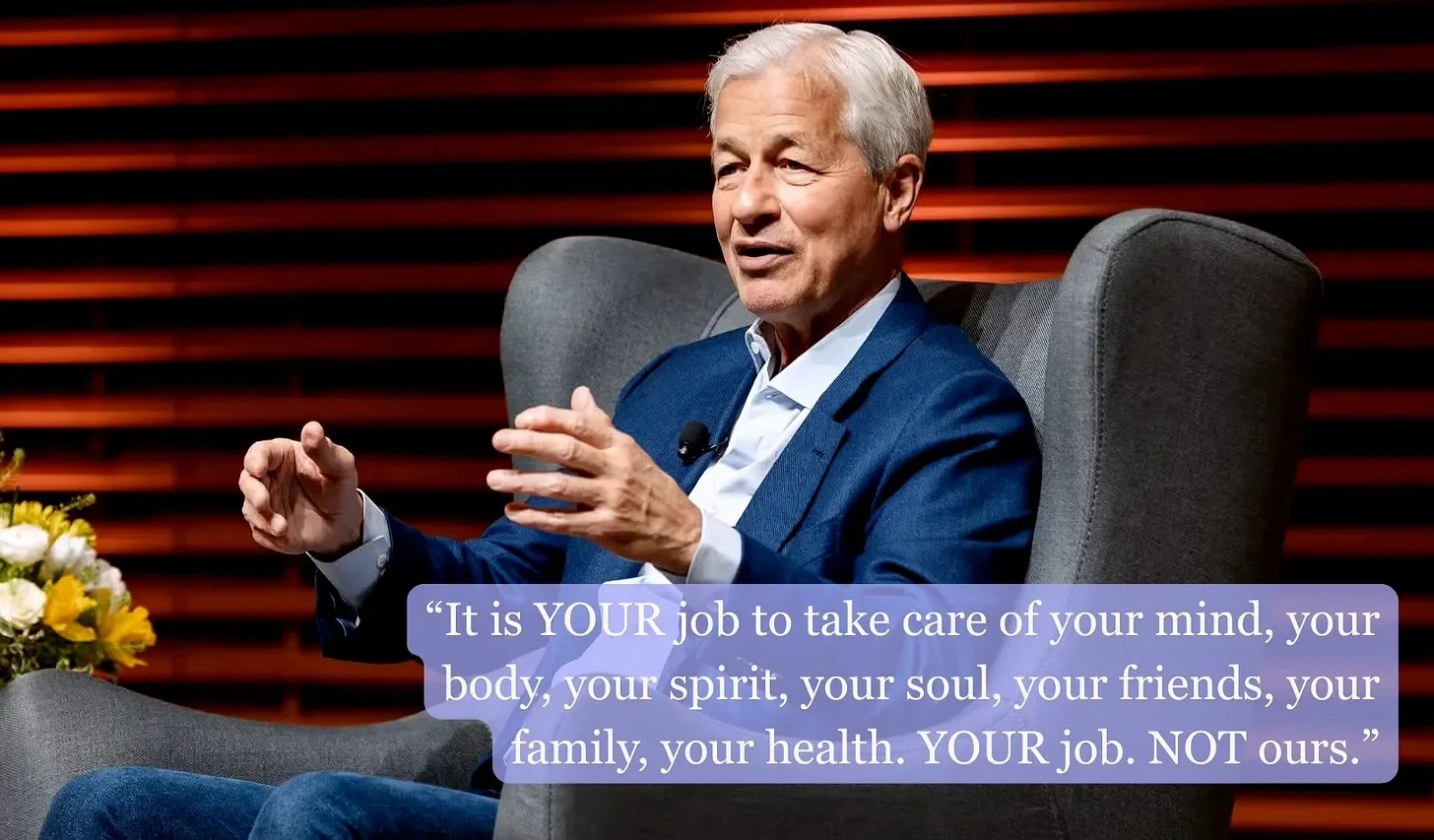
Jamie Dimon, CEO of JPMorgan. Picture credit: Stanford Graduate School of Business
Does that mean companies don’t and shouldn’t care about employee wellbeing? No, of course not. But this perspective shifts the corporate obligation from the prevention of mental or physical health conditions (where it has no business being) to providing support when those situations arise (which is precisely where a caring organisation should position itself).
Any organisation that claims this is not the case, and that its primary emphasis is on the well-being of its employees, is paying lip service to its corporate social responsibility obligations (put another way, it is lying in corporate).
So no. Corporations do not exist primarily to ensure their employees’ wellbeing. Which begs the question: why should their leaders?
As a leader your own wellbeing should be your priority - only then can you be the leader your team needs.
…and this might (/ probably will) include being “useful” to them.
But if we’re talking about well-being, then we have to consider what treatment for the opposite of well-being looks like. And any therapeutic process - whether for a physical or mental condition - puts the patient first. Not the patient’s itinerant direct report who has been creating stress within their team. You can’t lead others until you first lead yourself.
Let me pause to insert a real-world story from some work I’ve been doing with a client (who has agreed to me sharing this here). My client Lucy’s (not her real name) journey is a perfect illustration of the damage the servant leadership doctrine can do. She entered leadership determined to serve her team. In her interpretation, this meant unlimited support, availability, protection, and prioritisation of her team’s needs over her own. And for a while, it worked.
But over time, other things began to emerge: blurred boundaries, ateam stuck in decision paralysis, and the looming onset of burnout from carrying everyone else’s emotional baggage. So not only does this cost the leader something; it costs the team the opportunity to do their thing too.
In our work together, Lucy began to see that the servant leadership ideal is noble but flawed. Leadership isn’t about self-sacrifice. It requires personal effectiveness to come first.
Lucy’s done a lot of work with this realisation. She’s providing more direction. Setting clearer expectations. And requiring her team to be more personally accountable. The result is a style that still centres on empathy - that is who she naturally is, and we don’t want to lose that - but now she is pairing it with firmness, standards, and the courage to be outspoken in the service of something bigger than being liked.
And what has happened? The burnout has been kept at bay. She is happier, more confident, and more energetic. She has a clearer sense of her own purpose. And she knows what needs to be done. She is a better leader.
Serving is a good thing. There’s a certain nobility to it. Something tied up with the dignity of work and the contribution of the self to a greater cause. But serving at the cost of your own wellbeing and effectiveness? No. Never.